If one more person tells me that Pakistan has a better record
on women’s political representation than the ‘developed nations’
(meaning the US) because we have twice had a female head of state, I
will use my very female and very strong hand to slap them across the
face.
The Women in Politics Maps 2014 released by the Inter-Parliamentary Union (IPU) and UN Women recently ranked Pakistan 72
nd among 189 countries in terms of female representation in the parliament. We could have been ranked even lower – there is
no woman on Prime Minister Nawaz Sharif’s handpicked cabinet, for instance.

But one does not even need the IPU and UN Women to corroborate the
claim of women’s pathetic representation in Pakistani politics. All we
need to do is look north to Khyber Pakhtunkhwa (KPK) where Chief
Minister Pervez Khattak
just today told women lawmakers to refrain from suggesting development schemes and avoid tasks that fall under the duties of male members of parliament.
Since when has development been gender-specific, Mr CM?
Furthermore, in case his statement wasn’t patronising and
misogynistic enough, he also asked women legislators to concentrate on
policies regarding women’s welfare. I mean, seriously, if women have
such an itch to do something with the opportunity that’s been handed to
them by their benevolent male counterparts in parliament, they can stay
in their ‘zenankhana’ and discuss their women problems. Why do they have
to distract the ‘alpha men’ from their noble jobs as saviours of the
nation, including women?
So yes, what was it that you were saying about
women’s representation in Pakistani politics?
The truth is that Pakistani women parliamentarians have almost
always run second-fiddle to men,
which is why the findings of the Women in Politics report and KPK CM’s
comments shouldn’t come as a surprise at all. In the May 2013 election,
for example, an overwhelming majority of election rallies were addressed
strictly by men. In none of the mainstream political parties is a woman
in charge of anything remotely important, and a large majority of the
women who are now members of Pakistan’s National Assembly have made it
there on the reserved seats for women, not the competitive ones that are
open for contest among genders.
The female head of state we talk of,
Benazir Bhutto,
was only able to become the prime minister because she was her father’s
daughter. The reason she was nominated for prime minister was because
she was the chairperson of a national party that swept the elections, a
party also inherited from her father.
Perhaps it is because of this perceived ‘privilege’ that women
parliamentarians are barely ever taken seriously, a rather laughable
assumption to make if one were to spend a few minutes looking at how
much Pakistani legislators have contributed.
I would like to draw Mr Khattak’s attention, and that of every man
who holds the same view as him, to a report by non-profit legislative
watchdog,
The Free and Fair Election Network,
which showed that women parliamentarians in the outgoing National
Assembly were to be a lot more attentive than their male counterparts.
Despite being only 76 out of 350, women members asked 1,826 questions
out of a total of 3,314 questions that were posed. For some clear
perspective, read it like this: while women made up only 22% of the
Lower House membership, they asked 55% of the total questions asked
while the assembly was in session.
As the CM of the province, it is indeed Mr Khattak’s prerogative to
delegate legislative topics to his subordinates. However, I wonder if he
was just as concerned about the overstepping of gender boundaries when a
bunch of men decided to
usurp a woman’s right to decide who represents her in the Provincial Assembly that he was himself the head of?
On May 13, 2013, I had travelled to Lahore just to be able to vote – and
vote for Pakistan Tehreek-e-Insaf (PTI). I was then out in the street in Karachi, demanding re-election in NA-250. But the
party just keeps disappointing me again and again.
I know that many PTI supporters, some genuinely well-meaning and
respectful men, will respond to my tweets about this statement and this
blog with some sort of opaque explanations, but the message is clear;
the one certain change that is coming is that women can talk, until they
decide to challenge men on topics of consequence.
Thank you PTI for that reminder.

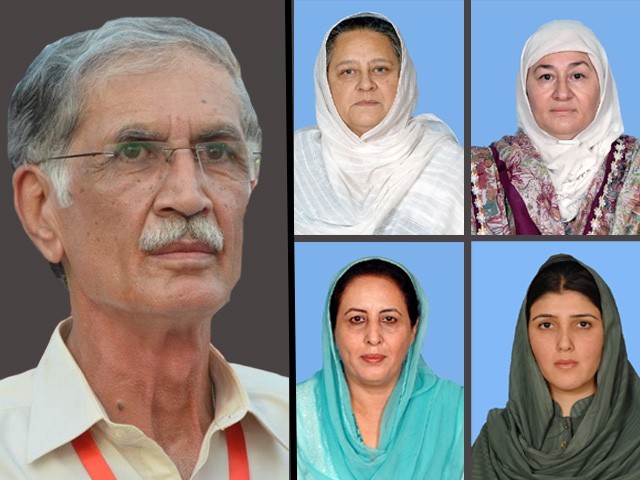 But one does not even need the IPU and UN Women to corroborate the
claim of women’s pathetic representation in Pakistani politics. All we
need to do is look north to Khyber Pakhtunkhwa (KPK) where Chief
Minister Pervez Khattak just today told women lawmakers to refrain from suggesting development schemes and avoid tasks that fall under the duties of male members of parliament.
But one does not even need the IPU and UN Women to corroborate the
claim of women’s pathetic representation in Pakistani politics. All we
need to do is look north to Khyber Pakhtunkhwa (KPK) where Chief
Minister Pervez Khattak just today told women lawmakers to refrain from suggesting development schemes and avoid tasks that fall under the duties of male members of parliament.